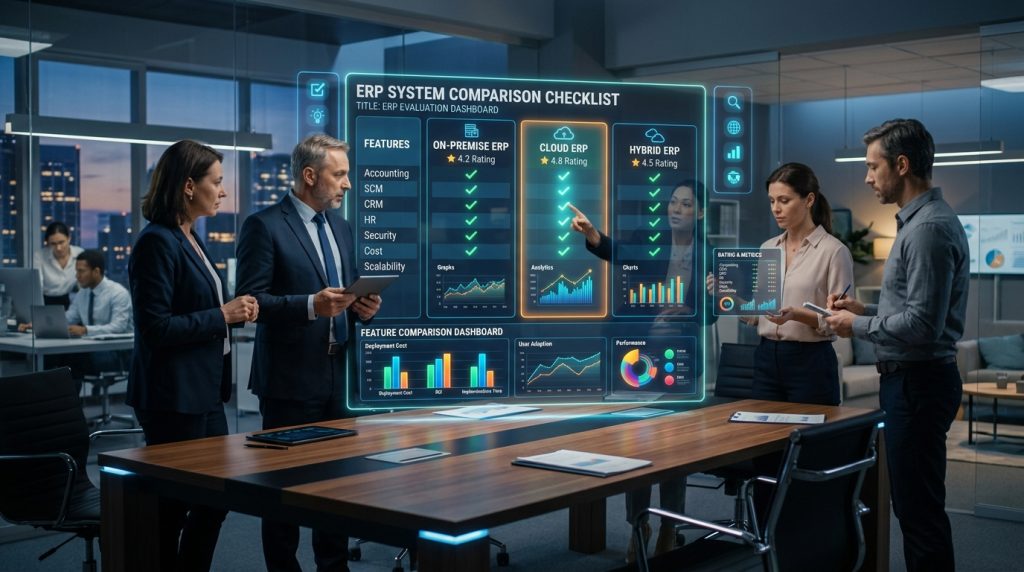

Enterprise Resource Planning (ERP) solutions are best evaluated using structured comparison checklists that help businesses choose the right system based on features, cost, scalability, and industry needs. A well designed ERP comparison checklist should include core modules such as finance, human resources, supply chain management, inventory control, customer relationship management, and reporting capabilities. Businesses should also compare deployment options including cloud ERP, on premise ERP, and hybrid ERP models to determine which best fits their operational requirements and budget constraints. Key evaluation factors in ERP checklists include integration capabilities, user experience, customization flexibility, data security, real time analytics, and automation features that improve efficiency and decision making. A proper ERP comparison also highlights vendor support, implementation time, training services, and long term maintenance costs to ensure sustainable business value. Using ERP checklists helps organizations avoid costly mistakes by systematically evaluating multiple solutions and selecting the platform that aligns with strategic business goals. In addition, businesses should consider scalability, industry specialization, and future growth potential when comparing ERP solutions to ensure long term success and adaptability. Modern ERP systems also offer advanced features such as artificial intelligence, machine learning, and predictive analytics, which should be included in any comparison checklist. Ultimately, a well structured ERP comparison checklist ensures better decision making, improved operational efficiency, reduced costs, and stronger digital transformation outcomes for organizations. It provides a clear framework for evaluating ERP vendors and selecting the most suitable solution for current and future business needs in competitive markets. By using standardized ERP comparison checklists, companies can simplify the selection process, improve transparency between stakeholders, reduce implementation risks, and ensure the chosen ERP solution delivers measurable value, long term efficiency, and continuous improvement across all departments within the organization for sustained competitive advantage in the digital business environment success growth stability today globally.
ERP Compare Guide